
Impression-Free Dentistry in Lucerne
At our practice in Lucerne we scan your teeth with an intraoral scanner – traditional, often unpleasant silicone and alginate impressions are a thing of the past.
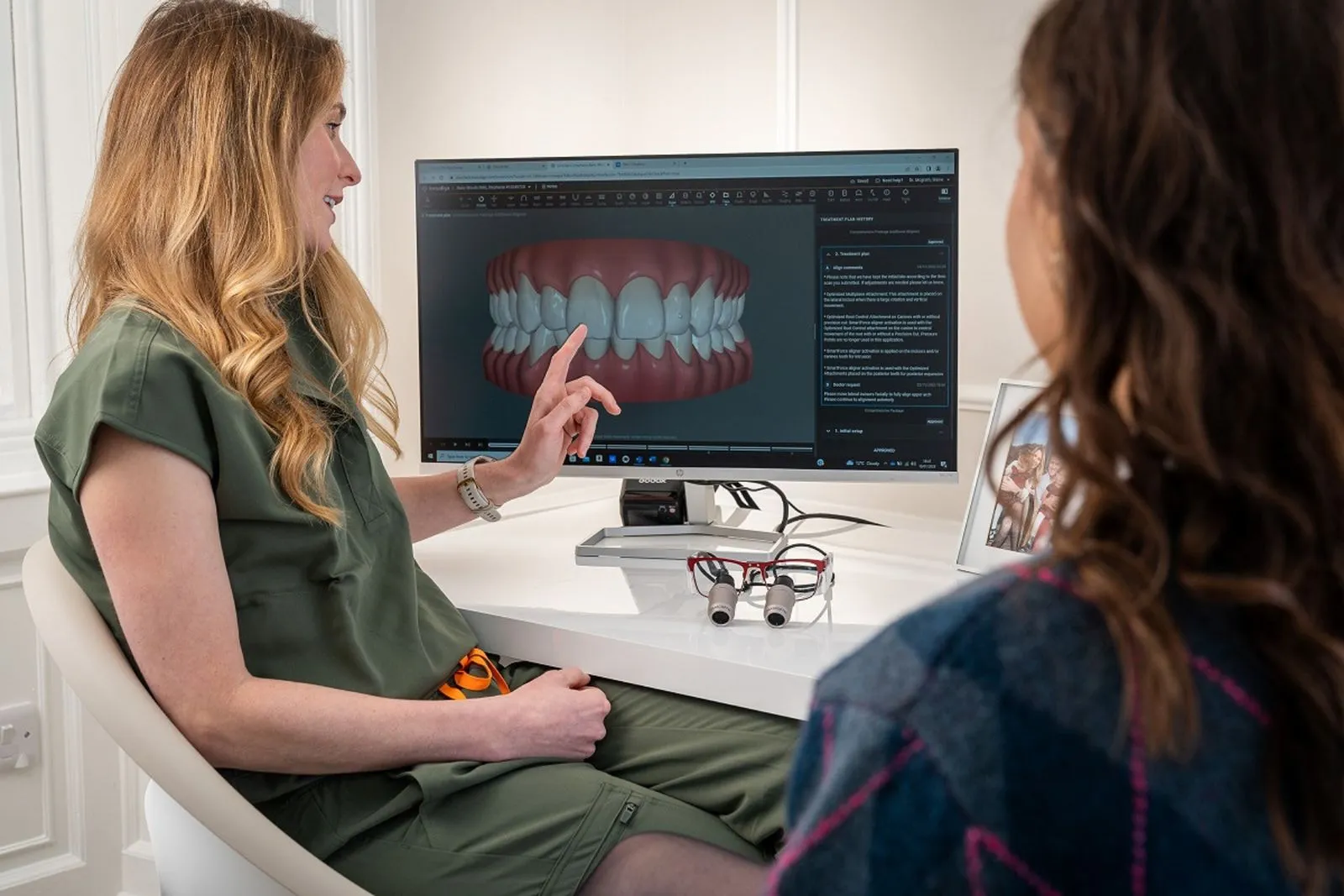
Impression-Free, Digital Dentistry in Lucerne
The digital workflow in Lucerne is more precise, faster and more comfortable. Crowns, bridges, aligners and splints can be planned and produced directly from the scan.
- Comfortable intraoral scan instead of impression trays
- Higher precision and better-fitting restorations
- Faster planning of crowns, bridges and aligners
- Ideal for patients with a gag reflex
What is an intraoral scanner?
An intraoral scanner is a small handheld camera that we guide over the teeth and gums. Software assembles the images into a precise 3D model of your mouth, which appears directly on the screen.
The digital impression replaces the conventional impression, in which a tray filled with impression material stays in the mouth until the material has set. Many patients find this unpleasant, especially if they have a strong gag reflex.
We use the scan data to plan and make restorations – for example all-ceramic CEREC crowns, which we produce directly in the practice – or send it digitally to the dental laboratory.
Benefits of digital impressions
Intraoral scanners offer a wide range of advantages in our daily practice.
- Precise 3D images of the teeth and mouth.
- No more uncomfortable conventional impressions.
- Faster, more comfortable capture of high-precision information.
- Simpler communication with the laboratory making your restoration – so you receive it sooner.
- Clearer patient communication: misalignments and leaking restorations can be shown on screen.
- Integrated caries detection: our Elements 5 scanner detects changes at an early stage. In this respect it is superior to conventional X-rays and is radiation-free.
- Orthodontic simulation: for misaligned teeth, the possible treatment result can be shown in advance, for example for teeth straightening with Invisalign.
What we use digital impressions for
Crowns, bridges and inlays
The scan is the basis for precisely fitting fixed restorations such as crowns, bridges, inlays and veneers. More under dental prosthetics.
Teeth straightening with aligners
For treatment with clear aligners, the teeth are scanned and the tooth movements are planned digitally. More on correcting misaligned teeth under orthodontics.
Implant planning
Combined with a 3D X-ray, the scan helps to plan the position of an implant and the restoration on it. It is the basis for guided implant surgery.
Splints
Splints are also made from the digital impression, for example a night guard for teeth grinding or a snoring splint.
How a digital impression works
- 1PreparationThe teeth are briefly dried so that the scanner can capture the surface accurately. No anaesthetic is needed.
- 2ScanWe guide the scanner head tooth by tooth over the upper and lower jaw and then record your bite. You can breathe normally, and we can pause at any time.
- 3Check on screenThe 3D model appears on the screen straight away. We check it for completeness, rescan individual areas if needed and discuss the findings with you.
- 4Further processingThe data is processed directly in the practice or sent digitally to the laboratory, without an impression having to be posted.
Frequently asked questions about digital impressions
Answers on the procedure, accuracy and cost of impression-free dentistry.
What is a digital dental impression?
A digital dental impression is a 3D scan of your teeth and gums, taken with an intraoral scanner. It replaces the conventional impression with impression material and is the basis for restorations, splints and the planning of orthodontic treatment.
Is the scan uncomfortable or does it trigger a gag reflex?
Most patients find the scan much more comfortable than a conventional impression. No impression material goes into the mouth, and the scanner head is small. If you gag, we can pause at any time. If you are anxious about dental treatment in general, see anxious patients.
Is a digital impression as accurate as a conventional one?
Yes, the intraoral scanner produces precise 3D images of the teeth and mouth. Because we check the model on screen straight away, we can rescan missing or inaccurate areas directly instead of taking a new impression.
Does the intraoral scanner use radiation?
No. The intraoral scanner works with light, not X-rays. The integrated caries detection of our scanner is also radiation-free. To assess bone and tooth roots, an X-ray is still needed where indicated.
Does health insurance cover the cost?
The digital impression is part of the treatment concerned, such as a crown or a splint, and is listed in the cost estimate. Basic health insurance does not usually cover dental treatment; supplementary dental insurance may contribute, depending on your policy.
Where does LifeDent offer impression-free dentistry?
At our practices in Lucerne and Volketswil. You can request an appointment online.


