
Guided Surgery in Lucerne
For guided implant placement, our team in Lucerne plans the implant digitally based on a 3D CBCT scan and intraoral scan. A custom-printed surgical guide transfers the plan precisely to your mouth.
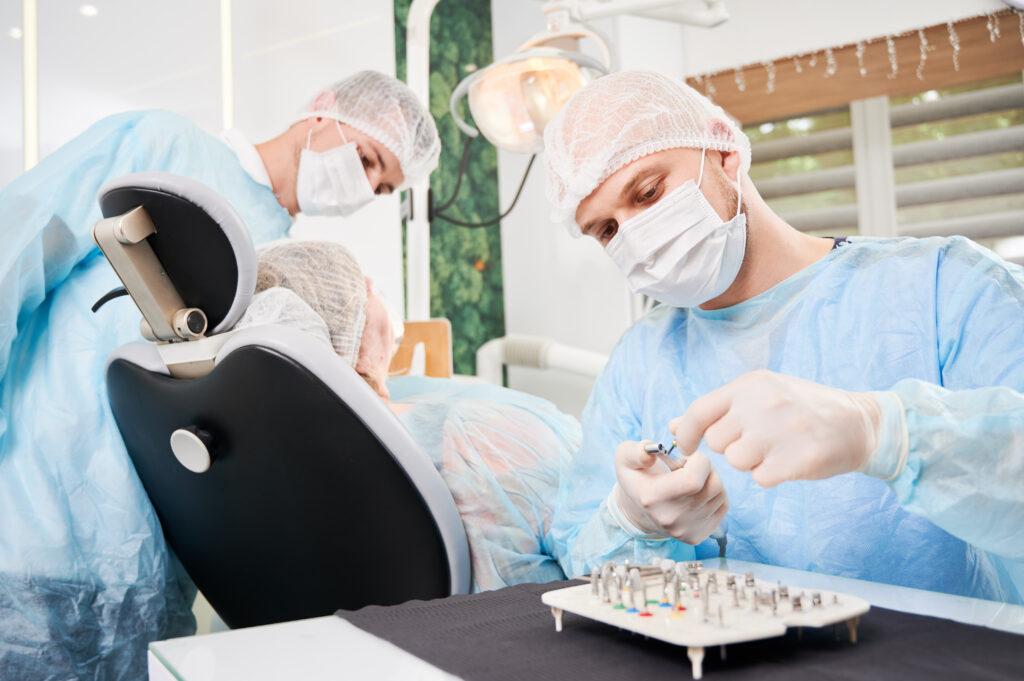
Guided Implant Surgery in Lucerne
The result in Lucerne: a minimally invasive procedure – often without incision or sutures – a short healing time and an implant in the ideal prosthetic position.
- Digital 3D planning based on CBCT and intraoral scan
- Custom surgical guide for maximum precision
- Often minimally invasive, without incision or sutures
- Shorter operating time and faster healing
What is guided surgery?
In dentistry, guided surgery refers to a procedure in which implants are positioned precisely using 3D-printed or milled templates. These templates act as a guidance or navigation instrument during the surgical procedure and ensure the exact placement of the implants. This results in improved accuracy, reduced invasiveness and, consequently, better long-term results.
It is based on digital planning using a three-dimensional X-ray (CBCT) and an intraoral scan. The custom-made surgical guide transfers this plan precisely to your mouth. The procedure is often so minimally invasive that no larger incision and no sutures are needed.
Guided surgery is part of our implantology and oral surgery and can be combined with titanium as well as ceramic implants.
How guided implant placement works
From imaging to the finished restoration in several steps:
- 1Examination and 3D imagingWe examine your teeth, gums and jawbone. Cone beam computed tomography (CBCT) shows the available bone, nerves and neighbouring structures in three dimensions.
- 2Intraoral scanYour teeth and gums are captured digitally with a scanner – without a conventional impression, as in impression-free dentistry.
- 3Digital planningThe X-ray and scan are merged on the computer. The position, angle and depth of the implant are planned so that it later fits the restoration optimally.
- 4Making the surgical guideThe plan is used to produce a custom surgical guide, 3D-printed or milled, that fits your teeth or jaw exactly.
- 5ProcedureUnder local anaesthesia the guide is placed in your mouth. It guides the drills so that the implant sits exactly where it was planned.
- 6Healing and restorationOnce healed, the implant is restored with a crown, bridge or denture – see dental prosthetics.
Advantages of guided surgery
- Precise implant positioning based on digital planning.
- Reduced invasiveness and less tissue trauma, often without a larger incision or sutures.
- Planning certainty and predictability.
- Shorter operating times.
- Better healing after the procedure and more comfort for patients.
Who is guided implant placement suitable for?
Guided implant placement is particularly suitable when there is little bone, when nerves, the maxillary sinus or neighbouring teeth lie close to the planned implant position, when several implants are placed, or when the smallest possible procedure is preferred. Whether guided surgery makes sense in your case is something we discuss after the examination.
If you are anxious about the procedure, the shorter treatment time helps. We can also discuss options such as nitrous oxide sedation; find out more under treatment for anxious patients.
Frequently asked questions about guided surgery
Answers on the process, pain, suitability and costs of guided implant placement.
What is a surgical guide for implants?
A surgical guide is a custom 3D-printed or milled template that is placed on the teeth or jaw during the procedure. It guides the drills to exactly the position, angle and depth that were planned beforehand on the computer using CBCT and an intraoral scan.
Is guided implant placement painful?
The procedure is carried out under local anaesthesia and is therefore usually painless. Because a larger incision and sutures are often not needed, there is less tissue trauma; many patients have less swelling and discomfort afterwards than after conventional implant placement.
How does it differ from conventional implant placement?
In conventional implant placement, the surgeon exposes the bone and positions the implant directly in the mouth. With guided surgery, the position is planned digitally in advance and transferred with a surgical guide. This makes the procedure more precise, more predictable and often shorter.
Which examinations are needed before guided surgery?
You need a dental examination, a three-dimensional X-ray (CBCT) and an intraoral scan of your teeth and gums. Inflammation such as tooth decay or periodontitis is treated beforehand. Find out more about the imaging under 3D X-ray diagnostics.
How much does guided implant placement cost?
The cost depends on the number of implants, the planning, the surgical guide, any preliminary treatment and the restoration. After the examination you receive a cost estimate. Basic Swiss health insurance generally does not cover dental treatment.
Where does LifeDent offer guided surgery?
We offer guided implant placement at our practices in Lucerne and Volketswil. In the consultation we use the examination and X-rays to establish whether guided implant placement is suitable for you. You can request an appointment online.


